Subhan Tahir • Personal Home • Glasgow to the World
FROM GLASGOW
TO THE WORLD.
Scotland made me the man I’m today. Now it’s time for me to give back.
🇵🇰 🏴 🇬🇧
People. Purpose. Progress.
Pakistan gave me my roots. Scotland shaped me. Britain gave me a platform. Now I am building products, sport, stories and opportunities with a global outlook.
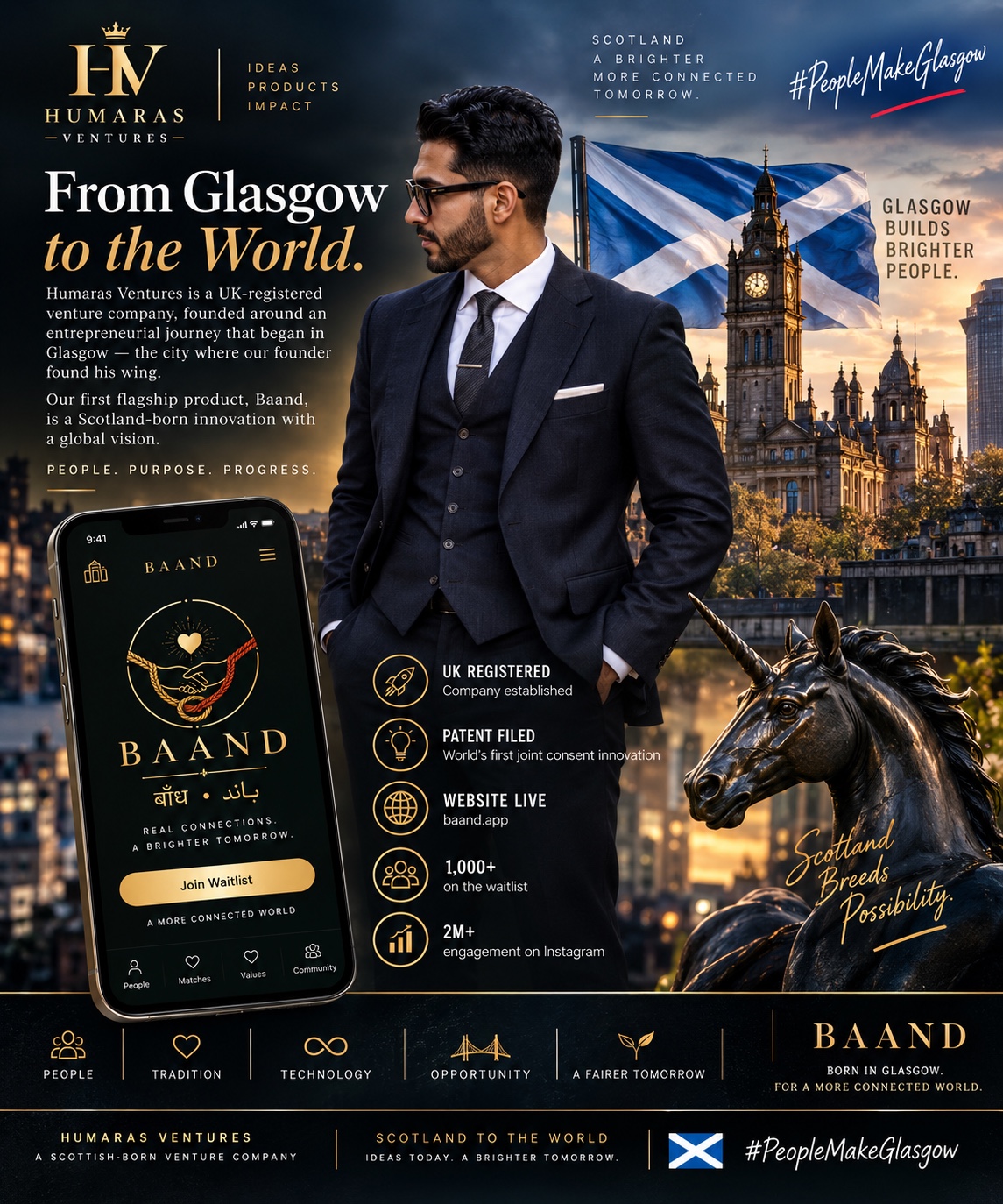
🇵🇰 Roots • 🏴 Scotland made me • 🇬🇧 Britain • 🌍 The world
The Journey
From Faisalabad to Manchester, then north to Glasgow — where work, sport, pressure and people sharpened the man behind the ventures.
Scotland made me the man I’m today.
The manuscript describes Glasgow as a place that slowly got under my skin — through its people, its parks, its character and the work of everyday life.
I worked across Zara, Subway, Marks & Spencer, restaurants, hospitality and call centres, learning something different in each one. The call centres taught me how language can calm a frightened or angry customer, how tone and timing matter, and how words can become bridges.
Now it’s time to give back.
The next phase connects the personal story to products and communities: HUMARAS Ventures, BAAND, BLUNT, SmashBall, music, writing and the wider public journey.
🇵🇰 Pakistan🏴 Scotland🇬🇧 Britain🌍 World
HUMARAS Ventures
Ideas. Products. Impact. BAAND is the flagship product in this portfolio, with BLUNT and SmashBall representing the wider build.
BAAND
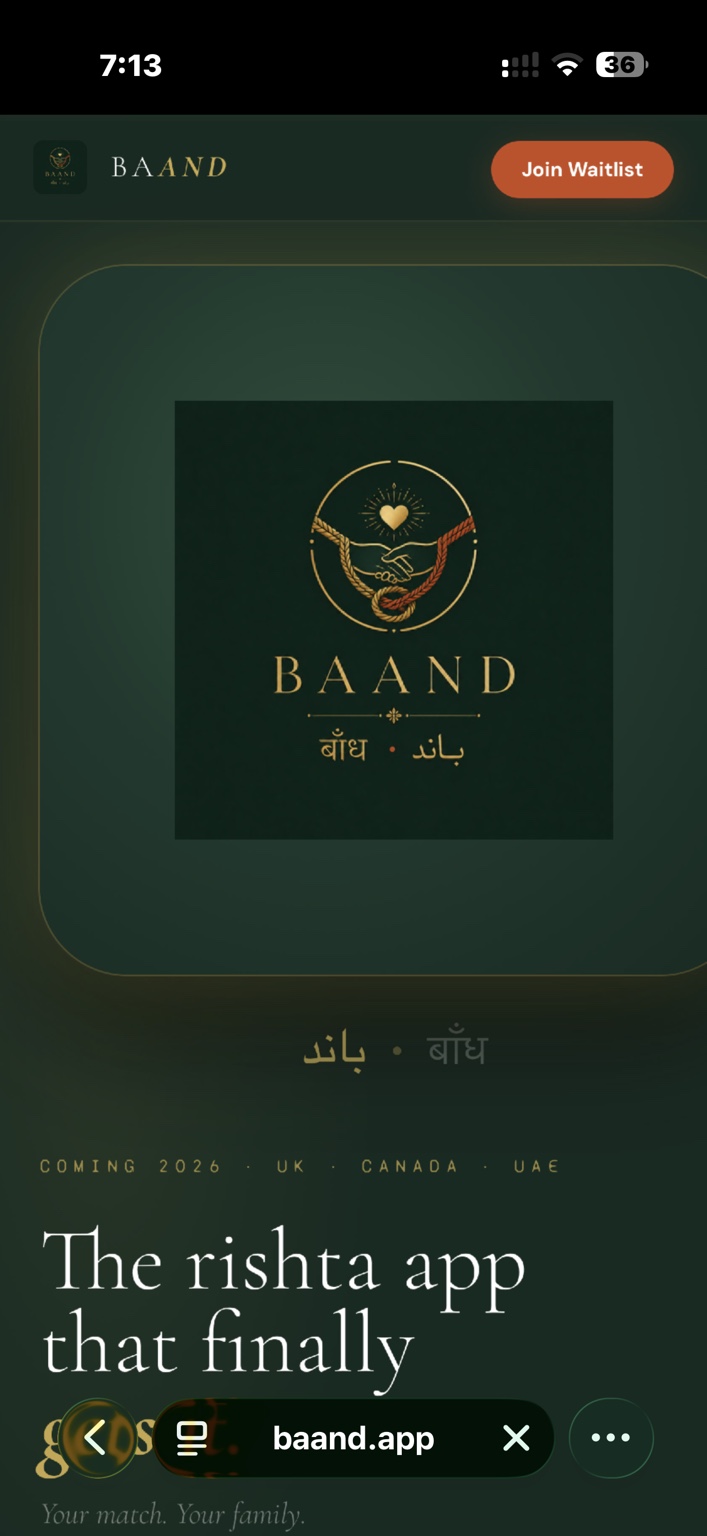
Flagship rishta product — family-aware, privacy-first matchmaking for the South Asian diaspora.
BLUNT
Youth-native AI tools built around clarity, highlights and better replies.
SmashBall
A new paddle goal sport built around short games, movement and scoring drama.
BAAND — Flagship Product
From Glasgow to the world. BAAND is the flagship HUMARAS Ventures product — a rishta app built to respect both generations without forcing either to compromise.
HUMARAS Ventures • Launching 2026
Your match. Your family. One yes.
BAAND says it was built because parents want to be involved while young South Asians want to choose. The product combines a family mode with a private personal view, keeping decisions private until the right moment.
Its stated launch markets are London, Toronto and Dubai, with the wider site identifying UK, Canada, UAE and Australia as key diaspora markets.
Family FirstPrivacy ProtectedCultural ContextUK • Canada • UAE
BLUNT — Cut the Yap.
BLUNT.FYI is a youth-native AI toolkit designed to remove the overwhelm: make long answers shorter, long demos into highlights, and awkward messages easier to send.
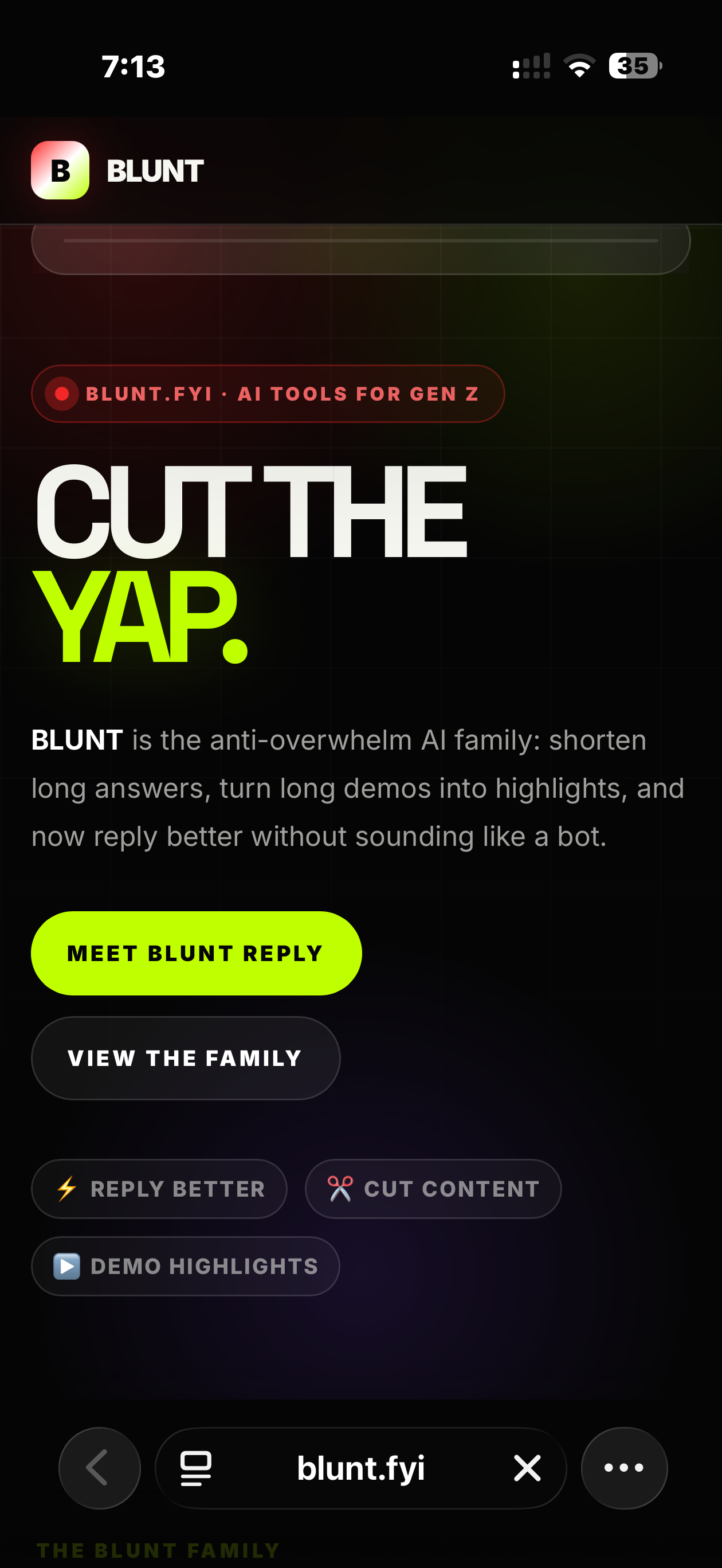
AI tools for people who think fast
One brand. Three sharp tools.
OG BLUNT turns long AI answers, essays, articles and notes into bullets, swipe cards, scripts and short summaries.
BLUNT Cut turns long product demos, tutorials and webinars into short highlights.
BLUNT Reply helps with texts, emails, DMs, recruiter replies, investor messages, friend-group comebacks and other situations where you need to “say it better.”
The site's thesis is simple: people do not need more AI; they need less thinking.
Reply betterCut contentDemo highlightsBLUNT FAM
SmashBall — Coming Soon
The new sport in the portfolio: a paddle goal sport born from an empty rink in Canada and designed for the court.
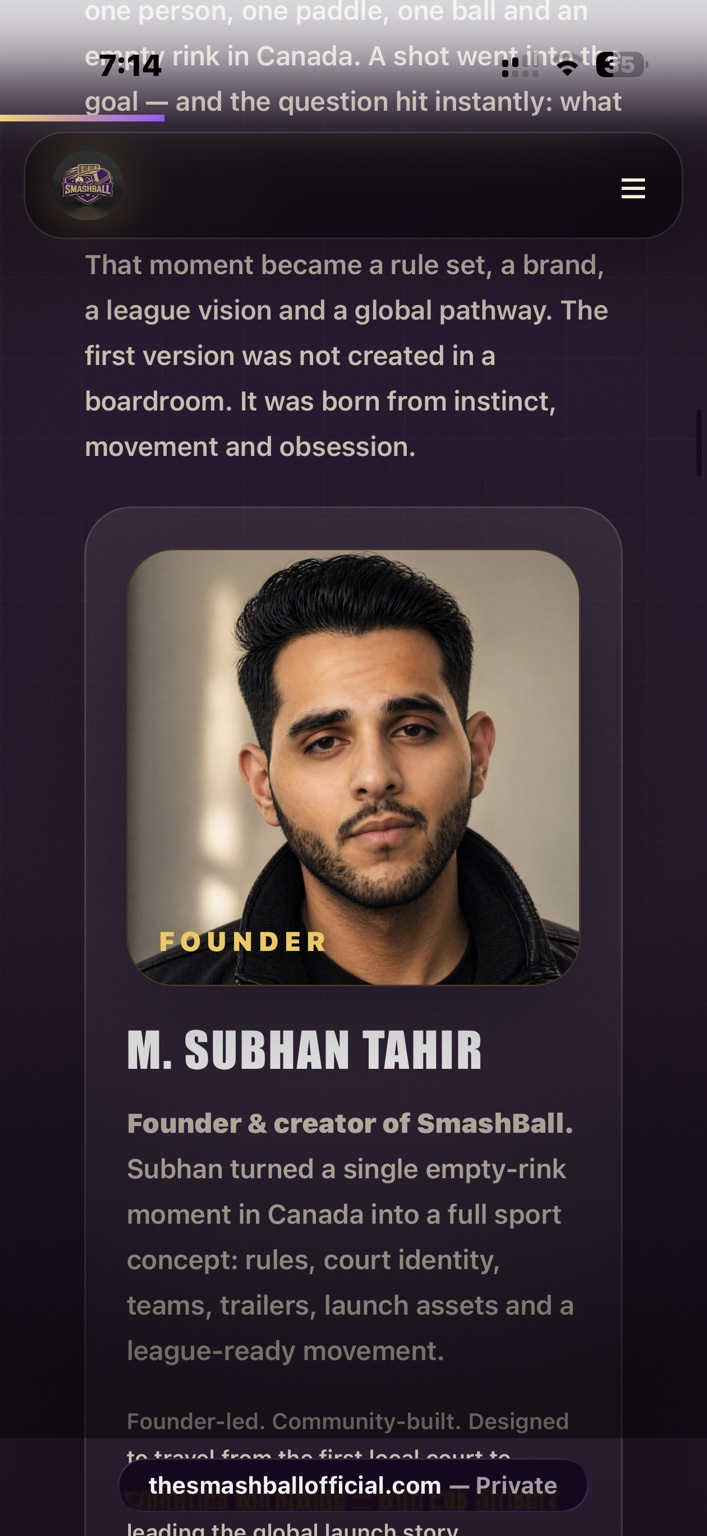
Founded 2026 • Born on the rink. Built for the court.
A sport people can understand in seconds.
The official site describes SmashBall as the world’s first paddle goal sport, combining racket control, court movement and goal-scoring drama.
The format is 2v2 or 3v3, with 8–12 minute games, a 3-touch maximum, and first to 7 while winning by 2. Players dribble, pass, bounce and smash the ball into the goal.
The positioning is pickleball finesse + tennis movement + hockey-style goals. The site traces the origin to 13 May 2026, when one shot in an empty Canadian rink sparked the concept.
2v2 / 3v38–12 minutesFirst to 73 touches maxGlobal pathway
My Glasgow
The song added to the new site — a Glasgow homecoming in sound.

MY GLASGOW • Subhan
“I wanna go back.” A song about Glasgow, memory and homecoming.
My Book
My Name Is Subhan — From Privilege to the Grind. The manuscript is being published as I live it — chapter by chapter, without pretending the journey was ever a straight line.
Scotland — The Cold That Sharpened Me
I did not want to go to Scotland.
Let me be honest about that, because this book is nothing if it isn't honest. Manchester had become mine. I had friends, rhythm, a life that was beginning to feel like it actually belonged to me. I was thriving — or so I believed. But you plan, and Allah plans, and Allah is the best of planners. So we went north.
I resented it at first. The grey skies, the cold that arrived early and stayed late, the feeling of starting again from scratch in a city that didn't yet know my name. I had already done this once — packed up everything familiar and walked into the unknown. I wasn't sure I had the energy to do it again.
And then Glasgow got under my skin.
It happened slowly, the way all real love happens — not in a single moment but in the accumulation of small ones. The green of the parks. The blue sky on the rare days it decided to show itself, so startling against all that grey that it felt like a gift specifically meant for you. But more than anything, it was the people.
Glasgow's official slogan is People Make Glasgow. I've lived in enough places now to know that most city slogans are marketing. Glasgow's is just the truth.
There was no performance to them. No carefully constructed friendliness designed to make you feel welcome while keeping you at a careful distance. The Scottish were something different. They genuinely wanted everyone around them to be happy, to thrive, to have enough. They killed with kindness and meant every blow.
I used to say it all the time: if they could just sort out the weather, Glasgow would be the perfect place to live.
I worked every job there was. Zara. Subway. Marks and Spencer. Restaurants, hospitality, call centres — I moved through them all, grafting every single day, learning something different in each one. But it was the call centres that taught me something I still carry. Working the phones for one of the big banks — customer service first, then fraud prevention — I discovered something about the power of language that no classroom had ever shown me.
Words are weapons. But used correctly, they are bridges.
Your tone. Your choice of words. The pause before you respond. In that job I learned how to take someone who called in furious — frightened about their money, their security, their life — and bring them back to calm using nothing but my voice. I learned to diffuse situations that could have escalated, to make people feel heard before I made them feel helped. I earned my emotional intelligence on the phone, one difficult conversation at a time.
And then one night during Covid, lying in bed, something shifted.
A restlessness, but a purposeful one. The feeling that the life I was living, good as it was, was not yet the life I was meant for. I lifted my laptop. I found the Police Scotland application. It was long. Detailed. The kind of form designed to make people give up halfway through. I didn't give up. I sat there at 4am and I typed. Question after question, and the strange thing was that the answers were already there before I finished reading the questions.
I submitted it and went to sleep.
At 10am, when I logged on for my shift, the reply was already waiting.
I had made the cut.
Some of the most important things in life were never the plan.
— — —
The Climb
When I decide something, I decide it completely.
The police application wasn't just a form I had submitted at 4am — it became my mission, the organising principle around which I rebuilt my entire life. I still had my day job. I still had my family responsibilities. But now I had something else — a dream that had arrived without warning and taken up permanent residence in my chest.
I lost 18 kilograms.
I want you to sit with that number for a moment, because it wasn't just weight. It was discipline made visible. It was 6am alarms when my body said no. It was tennis courts and swimming pools and meals planned and every small daily decision made in service of something larger than the moment.
Interview after interview — I cleared them one by one. The fitness test was not a problem. The bleep test — brutal, relentless — I nailed it. The written test, where numbers scared me more than anything, I somehow cleared that too.
What takes most people months — sometimes years — I had moved through in less than three months.
And then came the uniform fitting.
I stood there and I let myself feel it. All of it. The 18 kilograms gone. The 6am mornings. Standing in that room, being measured for the uniform of the thing I had decided to become — I was on top of the world.
I was wrong about what Allah's intention actually was. Because the fall was coming.
The story keeps moving.
Earlier chapters remain here alongside the newest chapters. This is not a polished story told from the finish line — it is the story as it unfolds.
And sometimes life takes a turn you never thought, never planned, and never could have written yourself.
Prologue
I am writing this at 2am.
Not because the world is quiet. Because it isn't. The world has never been louder — more surveilled, more algorithmic, more designed to contain your thoughts before they become dangerous to the people who benefit from your silence.
I am using artificial intelligence to tell my story.
Think about that for a moment. A boy from Faisalabad, the industrial capital of Pakistan — who crossed into Manchester, the industrial capital of Great Britain, at sixteen, who grafted through every job Glasgow had to offer, who lost 18 kilograms chasing a dream that was taken from him in an empty car park by two men who never intended to let him in — is now sitting in Canada at 2am using the most powerful technology ever built to make sure his voice reaches you.
They cannot stop this.
Not the systems. Not the institutions. Not the smiling faces that turned out to be something else entirely. Not the work permit that handed control of my destiny to someone else's desk.
My name is Subhan.
Like SubhanALLAH — glory be to God. I didn't choose this name. It was chosen for me before I understood what it carried. I spent years asking my parents why — what made them reach for a name that heavy, that full of meaning? And then life answered the question for me, one lesson at a time.
This book is not a success story.
Not yet. The victory is still being fought for — one namaz at a time, one day at a time, one thought at a time. Arsenal haven't won the title yet as I write these words. My Canadian chapter is still unfolding. The dream that was broken in Glasgow is still being rebuilt into something bigger than its original form.
I am not writing from the mountaintop.
I am writing from the climb.
And that is precisely why you need to read this.
Because you are climbing too. I can feel it. You picked this book up because something in the title, the cover, the name — something spoke to the part of you that has been buried under noise. The noise of survival. Of fitting in. Of smiling back at faces you slowly learned not to trust.
I am not writing this for money. I have never measured my life in calculations of currency — I don't understand that language and I never have. The measure of what I achieve is simple: how many people does this reach? How many people pick this up broken and put it down believing again? That is my currency. That is the only number that has ever mattered to me.
Nobody in this world is truly secure about what comes next — not the powerful, not the wealthy, not the people who think their systems and structures protect them. The future is not in anyone's hands. So I made a decision a long time ago to stop fighting that truth and start living inside it. Do your work. Be present. Be good. What is coming to you will come. What isn't, won't. This is not fatalism — I am not a man who sits and waits for destiny to arrive at his door. I work. I fight. I show up every single day. But I have made peace with the part I cannot control. And that peace is the most radical, most genuinely free thing a person can choose in the world we live in today.
Ninety percent of my decisions have come from one place — my heart. No spreadsheet, no strategy, no five year plan. Just an internal voice that has never once steered me wrong when I was honest enough to listen to it. I give it one hundred percent and I hope for the best. This book, my future wife, my children yet to come — these are not accidents waiting to happen. They are invitations I am walking toward. I am like life itself. Unplanned. But never without purpose.
ہم کامیاب ہوں گے
We will be successful.
Chapter One — The Beginning — Pakistan
Before Everything — The Miracle
I was born in Faisalabad, the industrial capital of Pakistan, on March 28th, 1999.
I was born a miracle. Not metaphorically. Medically. Literally.
A year and a half after my brother Hayyan, I arrived into the world weak and ill. The doctors were worried. They were honest about it with my parents — this child is struggling, his body is not strong enough, we are not sure he will make it.
I was placed in the intensive care unit. Over twenty days. The machines beeping, the monitors watching, the particular silence of a hospital ward where life and death are negotiating in the space between.
Every doctor, every nurse who came near my parents said the same thing: Keep praying. That's all you can do now. Keep praying.
And my parents did.
After more than twenty days, my father walked into that hospital ward and something changed. The atmosphere shifted. The nurses and doctors came to him with words they hadn't said before.
There's been a miracle. Your baby has made a miraculous recovery. He's going to be okay.
That is how my story in this world started. Not with a birth certificate. But with a miracle. With prayers answered. With a child the doctors had given up on, walking out of that hospital ward alive.
My parents named me Subhan. Like SubhanALLAH — glory be to God. Because they knew, from the first moment they held me, that I was here for something. That I had been brought back for a reason.
I spent my entire childhood not fully understanding what that meant. But I felt it. In the way my mother looked at me. In the way she knew what my heart wanted before I asked. In the way impossible things kept happening when I needed them to happen.
I was the miracle baby. And somehow, that changed everything about how I moved through the world.
Grade 4 — Learning What It Means
I was in Grade 4 when I first understood, without having the words for it, that I was wired differently.
My father had given us everything a child could ask for — a grammar school education, a driver waiting at the gates, a home full of warmth and the kind of stability that most people only dream of. We were privileged, and I knew it, even then. But it was my mother who gave us something no money could buy. She was a Hafiz of the Quran — a woman who had committed the entire word of God to memory — and she passed that into us not through lectures but through the quiet, daily example of how she moved through the world. Right was right. Wrong was wrong. And somehow, even at seven years old, I always knew the difference.
I don't remember his name. But I remember him.
He was a boy in my class — specially challenged in ways that none of us had the language for at that age. Children are not naturally cruel, but they are naturally oblivious, and most of my classmates simply didn't see him. Not really. They moved in their packs, chasing their own noise, going left because everyone else was going left.
I went right.
I don't know what made me do it — I won't dress it up as some grand moral decision, because it wasn't. It was just something in me that couldn't look away. I became his friend. I walked with him. I saved him a spot in the busy cafeteria line, pushed through the crowd to get him what he wanted, waited for him after class when everyone else had already gone. I did it selflessly — I know this because at that age, you cannot fake selflessness. Children don't perform kindness for an audience that isn't watching.
And then something would happen that I've never been able to fully explain.
I'd climb into the car at the end of the school day, driver waiting, school bag heavy, stomach growling — craving something specific, some particular dish that had been living in my mind all afternoon. And I would walk through the front door, and the smell would hit me before I even crossed the threshold.
My mother had cooked exactly what I was craving.
Every time.
It happened too often to be coincidence, and I was too young to be cynical about miracles. I knew — in that deep, wordless way that children sometimes know things — that Allah was answering something. That the goodness I had put into the world during the day was coming back to me in the evening, wrapped in my mother's cooking, carried in the smell of a home that loved me.
I was seven years old and I had already learned the most important lesson of my life:
What you give, returns to you. Maybe not how you expect it. But it returns.
— — —
Hayyan — The Brother Who Taught Without Knowing
There were three of us.
Mahnoor — the eldest, my father's princess, the one who carried the family's hopes the way only a firstborn daughter can. And then there was me and Hayyan, just a year apart, close enough in age that the world often blurred the line between us, far enough apart in temperament that we could not have been more different.
Hayyan was my best friend, my elder brother, my first role model — and my first classroom.
We shared everything. The same school, the same home, the same driver waiting at the gates, the same mother's cooking filling the house at the end of the day. I watched him the way younger brothers watch their elders — not with envy, but with a kind of quiet, careful attention. He was the road ahead of me and I was reading every sign.
I saw him lie sometimes. I never told a soul. That wasn't my place and it never would be. But I filed it away somewhere deep — the feeling it left in my chest, the way it sat wrong with me even when I had no words for why.
I watched how he sometimes spoke to the house staff. It wasn't malicious — he was a child, the eldest son of a wealthy factory owner, growing up in a world that had a certain order to it that everyone around us simply accepted. He was navigating what it meant to inhabit that position, the way all children navigate the world they are born into. He was on his own journey. I understood that even then.
But I was on mine.
Hayyan wasn't a bad person. He was never that. He was a boy becoming a man, carrying the weight of expectation that comes with being firstborn and favoured. His journey was his own — full of its own lessons, its own growth, its own arriving.
But watching him taught me something I could not have learned any other way:
You don't need to be told who to be. You just need to be honest enough to notice when something feels wrong — and brave enough to choose differently.
That was the gift my brother gave me, without ever knowing he gave it.
— — —
The Women Who Shaped Me
I grew up in a female-dominated household as the youngest son.
That is not a small thing. That is everything.
My mother — the Hafiz of the Quran, the woman who somehow knew what my heart craved before I walked through the door — she was the spiritual anchor of everything. Right and wrong lived in her presence. Not as rules but as a lived example. The way she moved through the world, the choices she made, the softness in her eyes that came from something deeper than genetics — that was the education no school could have given me.
And then there was Mahnoor.
My eldest sister. Daddy's princess, the only daughter, carrying the weight of that particular role in a Pakistani household. She was groomed for a certain life — the beautiful, dutiful daughter who would marry well and continue the story as it was written. And for a time, that was her path.
But life had other plans.
I watched my sister navigate things I was too young to fully understand at the time. Expectations. Marriages. The particular pain of a woman in a traditional family who finds herself having to rebuild everything — not just her life, but her identity, her understanding of who she was supposed to be versus who she actually was.
And she did it. In a foreign country. As a single mother. Learning to be not the princess Daddy raised, but the warrior that circumstance demanded.
I have immense respect for my sister. Because I have watched her refuse to be broken by things that would have broken most people.
And then there were my nieces — Meerab and Alaiha.
My first daughters. That's what I call them. Because growing up watching them, shaping them, being present in their lives in a way that maybe I wasn't supposed to as an uncle — they became like my children. And through them I learned something I might never have learned otherwise.
I learned what it means to raise women. Not to protect them from the world, but to prepare them for it. To teach them that their softness is not a weakness. That their resilience is not masculine. That they can be both gentle and fearless, both kind and sharp, both loving and completely, unapologetically themselves.
I see them becoming women now — Meerab and Alaiha — and I see the marks I helped put there. The belief that they are enough. The knowledge that the world will try to make them smaller and they don't have to accept that. The understanding that a woman's strength is not measured by how well she fits into a man's world but by how fully she builds her own.
My mother taught me faith. My sister taught me resilience. My nieces taught me what it means to believe in women before the world does.
And then there is Mahnoor's light — the Noor in my life.
I won't say much more than that. Some things are sacred. Some relationships are meant to be lived rather than explained. But I want the world to know that in the darkest moments, in the car park in Glasgow, in the waiting for the work permit, in the uncertainty of Canada — there has been a woman whose presence alone was enough to remind me that I was not alone.
ہم کامیاب ہوں گے — we will be successful — is not just about me. It's about every woman who has carried more than her share, who has loved fiercely, who has refused to be diminished.
This book is for them.
This is where my story took a turn I never thought or planned.
I was writing my life as it happened. Then life happened in ways I could never have planned for. These chapters are part of the story — the hospital, the complaint, the bridge, Ward 36, Wren Ward, the tribunal, release, and the choice to keep moving forward.
But God ☝🏽 is the best of planners.
Chronology • 23 days on Ward 36 → 12 days on Wren Ward • 35 days total
BAY 14
My mother was admitted to Ward 410 at the hospital on 6 June 2026, after a stroke. I flew from Canada, landed on 14 June, and drove down from Scotland to reach her. From 15 June I was at her bedside every day until she was discharged on the 20th.
Bay 14 was the one position in that entire ward with no window. No daylight, no outside view, nothing beside her but a blacked-out panel. The other beds in that same bay — occupied by white patients — sat beside large windows, sunlight falling across their sheets every morning. My mother, frail after a stroke, unable to walk to a window herself, was given the one bed in the ward built without one.
She was also, in practice, cared for differently. The white patients near her were attended by nurses. My mother — a registered disabled woman, Pakistani, Muslim — was largely left to care assistants. Not occasionally. As a pattern, day after day, for the two weeks I stood there and watched it happen.
There was a bin beside her bed that was slammed, repeatedly, including through the night, from the day she was admitted. I raised it with the nurse in charge. Her response was dismissive — in her words and in the way she held herself — and she pointed me toward PALS instead of taking it on herself.
I raised the window position with three different nurses in charge over those two weeks. Each one listened. None of them moved her, or explained why she couldn't be moved.
I filed a complaint with PALS. I was told someone would follow up by email. A week later, nothing.
On the day she was finally discharged, her bags packed and ready, doctors did their rounds and walked past her without signing her off. Staff sat at the front desk on laptops while my mother waited to go home. When I said plainly that I intended to take this further, a doctor — Dr Munir — raised his voice at me in front of my mother, in front of other patients, in front of my family, as though embarrassing me would make me stop asking.
I didn't raise my voice back. I stayed calm, because I had already learned, in a car park in Glasgow years earlier, exactly what it costs a man like me to lose his composure in front of a uniform.
What I did instead was write it down. Every date, every name, every incident, laid out the same way I laid out the case that beat a major bank months earlier — not with anger, but with evidence. I filed a formal complaint under the NHS's own regulations, citing the standards the Trust had failed to meet: dignity, respect, safe care, a properly handled complaint. I named what I believe this was — my mother, a disabled Pakistani Muslim woman, treated less favourably than the white patients beside her, in a system built on the promise that it looks after everyone the same.
Three months of back and forth followed. Questions, delays, more of the same scrutiny and dismissiveness that had put her in that bed by the blacked-out window in the first place.
In the end, my mother and I sat down and made a decision together. We withdrew the complaint. Not because it wasn't true. Not because I couldn't have pushed further — I had already proven, months earlier, exactly how far I'm willing to go when something is worth fighting for. But because my mother asked for peace instead of a war she'd have to keep reliving every time she gave a statement.
We chose to forgive. Not because the system deserved it. Because we did.
That is not weakness. I have learned, the hard way, more than once now, that walking away with your dignity intact can be its own kind of winning — even when the scoreboard says otherwise.
SWEET PRISON — WARD 36
5 August 2026
There are moments in life when you can trace the exact second everything changed.
For me, it was 5 August 2026.
I had spent months shouting into systems that seemed incapable of hearing me.
My mother had suffered a stroke. I had travelled across countries to be beside her. I had raised concerns about what I believed was happening to her in hospital. I had complained. I had written. I had contacted authorities. I had contacted elected representatives. I had tried to make people listen.
I had contacted Derbyshire Constabulary.
Greater Manchester Police.
My local MP, Beverley Craig.
Baggy Shanker.
Andy Burnham’s office, after his election as Prime Minister.
I had emailed offices. I had tagged people online. I had repeatedly tried to get somebody — anybody — to engage with what I was saying.
I felt as though every door was closed.
And eventually, I reached a place where I could not see another door.
On 5 August, I was on a bridge, preparing to jump.
I am not writing that sentence for drama.
It is the truth of where I was that day.
And then a woman I did not know intervened.
She spoke to me.
She stayed.
She called the police.
Most importantly, she kept me talking.
Sometimes a life changes because of someone whose name you never even learn.
The police arrived.
By then, I had calmed down enough to speak.
For almost two hours, I talked to them.
I explained everything.
The complaints.
The frustration.
The authorities I believed had failed to respond.
The people I had contacted.
The months of trying to be heard.
I told them why I had reached that bridge.
Then, as I pulled out my camera to record what was happening, I was detained under the Mental Health Act.
I want to be precise about this.
I am not saying that the detention itself was necessarily unlawful.
What I am saying is that, from my perspective, the circumstances surrounding how I reached that point were connected to a much longer story — months of feeling ignored, unheard and failed by institutions I had repeatedly approached.
That distinction matters.
Because this chapter is not simply about being sectioned.
It is about how I got there.
And then suddenly, I was inside Ward 36.
────────
SWEET PRISON
I spent twenty-three days in Ward 36.
From the outside, a locked psychiatric ward sounds frightening.
From the inside, reality is more complicated.
Ward 36 became its own little universe.
Netflix was running.
People joked.
Nurses came and went.
Doctors appeared with serious faces and serious questions.
And somehow, despite everything that had happened to get me there, I began making memories.
That was where Sweet Prison — Ward 36 came from.
I started writing the song as a way of capturing the strange reality of being there.
I turned the people around me into characters in my own little cast.
Dr Tanya became the GOAT.
Dr Dami Obi was calm and composed.
Jurdr, Janine, Susan, Habeeb, Kenny K, Helena, Alex, Ian, Tom, Drew, Brandon, Chrissy and Stephen all became part of the strange collection of people who filled those days.
Even the nurses became part of the jokes.
I was still myself.
Still observing everything.
Still making jokes.
Still finding something to laugh about in a place where there wasn’t supposed to be much to laugh about.
The song wasn’t meant to explain every detail of Ward 36.
It was simply how I remembered the feeling.
The irony of it all.
I was there because something had gone seriously wrong in my life.
I wasn’t free.
I didn’t know exactly when I would leave.
Yet I was making jokes about Netflix, giving the ward five stars and calling it a sweet prison.
Because sometimes humour is how you survive.
And sometimes the people you meet in the strangest circumstances become part of memories you carry long after you leave.
Ward 36 was twenty-three days of that.
Twenty-three days inside a locked ward.
Twenty-three days that began with one of the darkest moments of my life.
And twenty-three days that somehow still contained laughter, friendships, conversations and memories I would never forget.
Then I was moved.
And that was when the story changed again.
WREN WARD
After twenty-three days in Ward 36, I was moved to Wren Ward.
From the outside, Wren looked nicer.
It looked newer.
More modern.
But for me, it became a completely different experience.
And I hadn’t even been moved there because of anything I had done.
A patient on Ward 36 had suddenly gone out of control and, for no reason I understood, spat in my face.
It was humiliating.
The staff and doctors could see what had happened. They felt bad about it, and I was moved to Wren Ward.
I thought the change of ward might mean things would get easier.
Instead, I found myself struggling in a different way.
Wren may have looked better.
But to me, it felt like torture.
My back was aching.
I was asking to see a doctor.
I kept asking.
One day passed.
Then another.
Then another.
For six days, I was waiting to be properly heard.
Six days of asking for a doctor.
Six days of trying to explain what I was experiencing.
Six days of feeling as though my voice was disappearing into the walls.
Eventually, Dr Mohd Z came.
It was our first proper meeting.
And instead of the meeting giving me the reassurance I had been looking for, I was told that I was being placed under Section 3 of the Mental Health Act.
Six more months.
I remember thinking:
How did we get from me asking to be heard to another six months?
I had already spent twenty-three days in Ward 36.
Now I was facing the possibility of months more.
I didn’t simply accept it.
I hired lawyers.
I prepared for the tribunal.
And this time, I wanted everything to be heard properly.
Not through a rushed conversation.
Not through assumptions.
Not through somebody deciding what my story was without letting me tell it.
I wanted the facts put in front of the tribunal.
The lawyers knew my story.
I knew my story.
And eventually, the day came.
The tribunal lasted four hours.
Four hours of evidence, questions and arguments.
Four hours in which my case was finally heard in full.
And then came the decision.
The tribunal found in my favour.
I was free.
After everything — the bridge, the police conversation that lasted nearly two hours, the sectioning, twenty-three days in Ward 36, the move to Wren, six days waiting to be heard, the new Section 3 and the fear of another six months — I walked out.
Thirty-five days had changed my life.
I had entered the system at one of the lowest points I had ever known.
I left with something I had been fighting for from the beginning:
To be heard.
The experience became Six Days on Wren Ward.
Unlike Sweet Prison, it wasn’t written from a place of humour.
It came from frustration.
From waiting.
From wanting transparency.
From wanting accountability.
From wanting fair treatment.
But underneath all of it was one thing:
I still had a future I wanted to build.
BAAND.
Computer Science.
AI.
The ambitions I had before 5 August hadn’t disappeared.
They were still there.
The doors had been locked.
But my mind was already thinking about what would come after them.
And eventually, those doors opened.
I walked out.
“Scotland made me the man I’m today. Now it’s time for me to give back.”SUBHAN TAHIR • 🇵🇰 ROOTS • 🏴 GLASGOW • 🇬🇧 BRITAIN • 🌍 WORLD
Stay Connected
One home for the story, ventures, sport, music and next chapters.
Build. Create. Give back.
Subhan.it.com is the personal front door. The ventures live alongside the journey — with BAAND as the flagship HUMARAS Ventures product and BLUNT and SmashBall as distinct brands.